

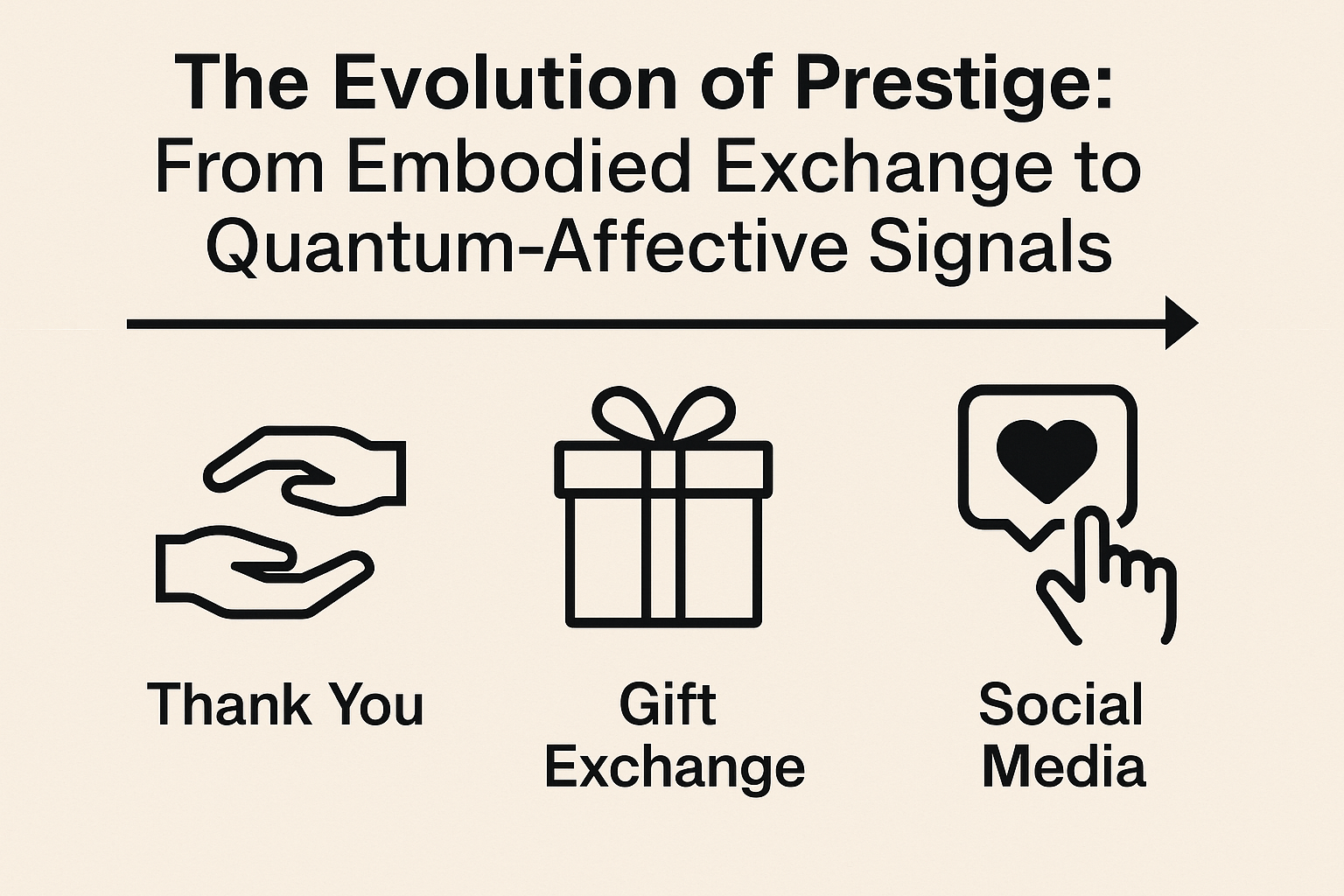
Across human history, prestige has always functioned as a social mirror—reflecting how communities value individuals and how individuals signal belonging, generosity, or emotional resonance. Yet the forms through which appreciation is expressed have never been static. They shift with culture, technology, and the deeper structures of how we relate to one another. What counted as prestige in one era can fade in another. What once anchored social meaning in physical exchange now moves fluidly across digital spaces. Increasingly, our expressions of appreciation resemble the quantum world: distributed, uncertain, entangled across distances, and open to multiple interpretations.
The simplest expression of appreciation—saying “thank you”—is one of humanity’s oldest social technologies. A verbal acknowledgment carries minimal cost but enormous symbolic weight. It establishes recognition, affirms presence, and signals that someone’s contribution has been noticed. In societies where interactions were largely face-to-face, gratitude worked because identities were stable and co-located. Appreciation was immediate, mutual, and embodied in the shared physical environment. A thank you was enough because the world was small enough for such gestures to travel their full distance.
But many cultures developed a deeper, more material vocabulary of appreciation: gift exchange. For the Māori, Yoruba, Polynesians, and countless others, gifts were extensions of the self. As anthropologist Marcel Mauss argued, they carried the spirit of the giver and created bonds of obligation and reciprocity. A gift was rarely just an object; it was a relationship materialized. Prestige, in this context, emerged from generosity, ritualized exchange, and the physical movement of value from one hand to another. This form of appreciation was slow, embodied, and heavy with meaning. It reflected a social world where relationships were long-term, communal, and grounded in shared material realities.
Today, however, appreciation has migrated into digital networks, where interactions unfold across physical and temporal distances. A like, comment, or repost can come from someone you have never met. A single gesture—delivered in milliseconds—can be seen by thousands. Meaning becomes layered, ambiguous, and dependent on interpretation. In this sense, digital appreciation behaves less like traditional social exchange and more like a quantum signal: nonlocal, probabilistic, and operating across fragmented identities. A like may be sincere, ironic, habitual, or algorithmically nudged; its meaning does not exist until the receiver interprets it. Social media has turned appreciation into a form of quantum-affective communication—simultaneously diffuse and immediate, intimate and performative.
The digital environment has also created a new emotional economy. Where gift exchange required time and material investment, digital appreciation is lightweight but infinitely scalable. A gesture that takes less than a second—tapping a heart icon—can accumulate into tremendous visibility and influence. Prestige becomes a function of attention rather than obligation, of amplification rather than reciprocity. In this world, identity is distributed across platforms, timelines, and audiences. People become networks, and prestige becomes the shape of one’s resonance within those networks. The center of gravity shifts from individuals to collective perception—a dynamic, fluctuating field of emotional and informational energy.
The result is a profound transformation in what appreciation means. We are moving from words that acknowledge, to gifts that bind, to digital actions that signal emotion across space and time. In a quantum-informed society, appreciation is no longer simply a message sent from one person to another. It is the emergent pattern produced by millions of interactions across interconnected systems. Prestige is no longer anchored in materiality or even in stable symbolic gestures; it is a living phenomenon shaped by algorithms, communities, and the fluid identities we project across digital borders.
As artificial intelligence, immersive technologies, and quantum communication continue to reshape human connection, the forms of appreciation available to us will expand even further. But the core insight remains: prestige evolves with the mediums through which we experience one another. Today, those mediums are increasingly nonlocal, instantaneous, and emotionally charged. What we are witnessing is not the disappearance of appreciation but its transformation. Prestige is becoming less of a static attribute and more of a dynamic field—an energetic signature shaped by visibility, resonance, and relational entanglement.
In this emerging world, our challenge is not to lament the shift but to understand it. Human appreciation is evolving, just as it always has. And in recognizing the quantum nature of our connections, we may discover new, more expansive ways of valuing presence, expressing gratitude, and honoring one another across the vast and vibrant networks that now define our lives.
 OLANREWAJU LASISI